Thursday, April 3, 2008

Roy Revisited

So, it's here. The moment we've all anticipated- the moment I have dreaded- when KU will finally face North Carolina and our former coach, Roy Williams. I'm not sure I'm ready for it, but honestly, I'm not sure I'll ever be ready for it. I guess I sort of hoped Roy would retire before ever having to play us. No such luck.

Am I still bitter he left KU? Yeah, I am. Roy's departure hurt. It made us look bad. The greatest coach in America, who had said that there was no better place than Kansas to coach, changed his mind. KU's reputation as the nation's premier basketball institution- including a claim on the game's founder and the country's best coach- was not merely undermined, it was disproven, and by the most credible of sources. Just the symbolism of Roy's departure hurt KU's stature in the basketball world. And it stung the fans, who believed him when he said "I'm stayin'."

Do I blame him for leaving? No, not really. No coach can be blamed for wanting to coach at his alma mater. And Roy, for his part, was always honest about his dual loyalties, even though many of us couldn't understand it. I respect the man, and as a KU fan I'm grateful for everything he did for us during his 15 years as KU's coach. But I won't cheer for him.

Some may think it's petty, but I can't cheer for Roy. It's not personal. I don't cheer for Duke or Syracuse, Arizona, UCLA, Kentucky or any other school besides KU. Particularly rival schools. And North Carolina clearly is a basketball rival of KU's. I guess that's the price he paid for joining a competing program. I certainly hope Roy has a good life, and I wish him all the success in the world- when he's out on the golf course- but as the head coach at North Carolina, I hope he doesn't win another game...

Especially the one against KU.

Monday, March 24, 2008

Do you Hulu?

Look out YouTube, there's a new Web site looking to capitalize on the popularity of Web-based video. Hulu.com is a new venture born of a partnership between NBC/Universal and Fox, along with several other partners, including Sony Pictures. Unlike YouTube however, which features low-quality user-generated content, Hulu serves up high-quality movies and TV shows on demand, for free (the service is ad supported). A typical 30 minute TV show would include 2 15-second promos at the beginning and end, plus one 30-second spot during the show. Advertisers feel that showing fewer ads will make them that much more memorable.


My take? I don't think Hulu.com will change the way people consume entertainment, but I agree with Entertainment Weekly when it said this will be just "one more way" people consume what Hulu calls "premium" entertainment. My only problem is with the assumption that people will accept the advertising model. When I encounter an ad that blocks me from the content I've tried to access, I view it about as happily as a pop-up. I try to close it or fast forward it, and when I can't, I'm not only less receptive to the message, I suddenly have negative feelings for the advertiser.

In an increasingly on-demand world where we can time-shift virtually any content, advertising that is forced is both unwelcome and increasingly antiquated. Although Hulu will suggest their model is permission-based, I think the industry needs to find new ways to reach (and interact with) audiences. Otherwise, solutions like Hulu will be viewed as somewhat less helpful than a DVR that enables millions of viewers to save programs and fast forward through the ads. Watch the video and make up your own mind.

Tuesday, March 18, 2008

Academic Differences

A report released Monday by the University of Central Florida's Institute for Diversity and Ethics in Sports compared graduation rates at the four number 1 seeded schools in the NCAA tournament. The results put UNC heads and shoulders above the rest, graduating 86% of its players compared to KU (45%), UCLA and Memphis (40%). The report, however, measured a period from the '97-98 school year through '00-01. Central Florida's release of such outdated data is misleading, irresponsible and opportunistic.

That's strong language. After all, the data is intended to highlight possible trends. The reason I take offense is simple. Since the time the study was conducted, KU's basketball program has a different Head Coach, a different academic adviser and a different A.D. Do those three positions have an impact on graduation rates or the extent to which they are a priority at a school? Absolutely. Could changing those three positions initiate a renewed committment toward academic progress and even change a trend over the course of 7 or 8 years? No question.

Central Florida's report would almost be irrelevant were it not for the national data that can be drawn from such a study, repeated over time. I guess the thing that gets me is the implication that North Carolina, under Head Coach Roy Williams, demonstrates a stronger commitment to academic progress than Kansas. With all due respect to Coach Williams and his staff, he was at Kansas during the length of the study, along with the program's academic adviser. It's unfair to compare this year's four number 1 seeds- their current coaches, players and athletic departments- using such outdated data. Whether KU fans like it or not, a lot has changed since Roy left, but KU's commitment to academic excellence remains as strong as ever.

Tuesday, March 11, 2008

Political Humor

Given that the U.S. is fighting an unpopular war in Iraq, and that Bush's approval rating is embarrassingly low, it would seem the democrats would have a lock on winning the White House. It would seem. However, as previous elections have shown, the dems can often be their own worst enemy. John McCain has been able to save his money and coast to the nomination while Hillary Clinton and Barack Obama spend millions attacking one another while trying to secure the nomination. It's almost funny. Enjoy this recent political cartoon.


Tuesday, March 4, 2008

The Cancer Question

The role of celebrities in this year's presidential election is interesting to watch, with famous endorsements coming in from all sides. Although it is admirable for stars to leverage their celebrity in support of a particular candidate, I'm more impressed by one who uses his to support a cause.


As I've noted before in this blog, I'm a fan of Lance Armstrong for the way he's used his celebrity to fight for the cause that is near and dear to him: Cancer. Last night, Armstrong appeared on Larry King Live to push for cancer to be a national priority after an unprecedented drop in federal funding for the National Cancer Institute. During his interview, Lance was asked the question "which candidate would do the most in the fight against cancer?" In other words, who would Lance be endorsing as the cancer candidate?

Lance has always contended that cancer is not a partisan issue and he's admirably remained non-partisan in his advocacy. He answered the question by saying that, obviously, every candidate opposes cancer. It is up to us to challenge them on this complex issue by comparing specific policies, such as whether they would support a national smoking ban, following the lead of 23 states that have adopted statewide bans to prevent the single most preventable form of cancer death in America. Where do they stand on early detection programs? Federal funding for drug discovery? Access to clinical trials? Treatment for the uninsured? The list goes on and on.

While other celebrities will support the candidate they believe can change the world, Lance is asking them to support his cause and his fight. To me, this is a tremendous example of leadership on both a public and a personal level, and it is why I admire the man even more than the cyclist. Last August, the Lance Armstrong Foundation hosted the first ever LIVESTRONG Presidential Cancer Forum, demanding that each candidate answer what Lance refers to as the "cancer question." I hope you'll watch the video below.

Monday, March 3, 2008

A Tradition of Dominance

A great player was humbled by a great team. In fact, player-of-the-year candidate Michael Beasley's quiet 39-point performance saved kstate from one of the worst blowouts in the lopsided history of sunflower showdown. With no other wildcat teammate in double figures, it was up to Beasley to deliver on his profoundly arrogant and ill-advised guarantees of victory in Manhattan, Lawrence, Africa or anywhere the two teams would play. He failed, spectacularly.

Before the tipoff, Mike Lickert and his world-class videoboard team delivered one of the most stunning video tributes to Kansas Basketball I've seen- mainly due to the way it took an incredibly amped crowd and sent them into a fever pitch. Not the loudest I've ever heard (not even the loudest this season- a distinction clearly earned by the half-time presentation of the Orange Bowl trophy during the MU game)- but deafening by any standard. This was without a doubt the biggest kstate game I've seen in Allen.

And what to make of it? Although kstate's surprising win in Manhattan may have led some to consider the possibility of ksu sweeping the Jayhawks in basketball, Saturday's victory proved one thing. One victory in 25 years for kstate against the Jayhawks in Manhattan is considered absolutely unacceptable by KU standards. Without kstate having recruited (shockingly) a "player-of-the-year" candidate who poured in 39 points, can you imagine the outcome? A great player was humbled by a greater team, and as the pre-game video showed, KU's is a tradition of dominance. See you in Africa...

Monday, February 25, 2008

Branding Obama

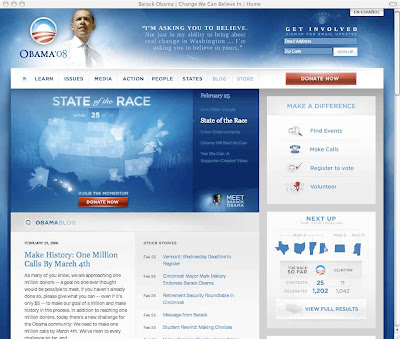
In this historic presidential race, one thing has become increasingly clear: Barack Obama has become arguably the most well-branded candidate in history. Advertising Age featured an article today attesting to Obama's popularity, and the fact that he's managed to carry a significant demographic: the so-called creative class.

Obviously, every candidate is using the internet, and history has even seen a few internet candidates, such as Howard Dean, who was among the first to capitalize on new media and the grassroots, viral support it could generate. Ironically, Dean's campaign was undone by a media-driven sound byte that overcame his message. Obama's campaign is different and significant for a few reasons.

He has not only leveraged the web, he's refined his message to simple, web-ready language that resonates with online audiences (younger, creative and affluent audiences) while maintaining a strong base off-line using the same message. It's a message, like all great brands, that can be boiled down to one or two words. It's a message of hope and change.

Obama's campaign has spread online largely through free, consumer-generated media, and it's gaining the lion's share of online interest. According to Ad Age, which cited the web-analytics firm, Compete, Obama's content generated triple the "FaceTime" of Clinton's while beating McCain's content on YouTube nearly 36 to 1.

Part of the reason is not merely due to the quantity of Obama's base of support. It's the quality of his support base that is allowing his content to thrive. Mash-ups and viral videos like Will.i.am's "Yes We Can" video (the subject of a previous blog), "Vote Different" (a nod to Apple's famous 1984-themed ad), plus "Hope Changes Everything" (below) and of course "Obama Girl" all have enjoyed tons of play time and rank among the top viral videos on the web.

Perhaps it's because many of these efforts were contributed by creative professionals drawn to Obama. Take Shepard Fairey for instance. From Advertising Age:

"His politics fall perfectly in line with what I do as an artist," said urban artist and guerrilla marketer Shepard Fairey, an Obama fan since 2004 who offered his endorsement via a striking poster series. "In advertising and marketing, things are simplified to accentuate the positive and utilize soundbites that are really powerful; it's about economical communications, and [Barack Obama] is really good at that," said Mr. Fairey. "That type of approach to politics -- when it seems like he really has conviction, too -- is really easy to distill down to marketable images. It felt really easy for me to make a poster for him." (see Fairey's poster above)

The New York Times also weighed-in on the brand-power of Obama February 4th when they compared candidate Web sites, claiming Obama's to be the more Mac-like versus Hillary's PC-like site. Despite Apple's small market share that in political terms could be considered a marginalized group, the comparison makes Obama's site the more creative, easier to use and compelling site, gaining Apple's enviable brand attributes and the rabid support of like-minded Mac fanatics (who make up the majority of the so-called creative class).

Obama's appeal extends to many groups but perhaps the most meaningful group of supporters is this young, affluent, creative class that is carrying his multi-medium message to the masses, and is, in the process, building a tough brand to beat.

Tuesday, February 12, 2008

John Edwards & Cross Country

Heading into the Potomac primaries, Obama and Clinton are in a tight race to gain the party's nomination for President. Both have secured over a thousand delegates and are virtually tied while other contenders have dropped out of the race, including John Edwards. Yet, oddly enough, Edwards will be the key to breaking the deadlock.

His situation reminds me of an experience I had running cross country my freshman year in college. I was the fifth best runner on the team. In the race that would determine whether or not we would go to nationals, I felt my role was inconsequential, since the top runners on the team would surely hold our fate. Coming down the stretch, battling to pass one more runner, my teammates cheered like mad. It turned out that I needed to beat one more runner for us to get to nationals, and I was the team's final scorer. I passed the guy, and we qualified for nationals by one point. Although I received the credit, I learned the value of a team that day, and that you don't have to be in the lead to be a leader.

John Edwards no doubt hoped to be his party's nominee, much like I aspired to be our team's top runner. Now, he's the presumptive vice presidential pick whose coveted endorsement will tip the balance, bringing with it a host of delegates earned before he left the race. With Bill Clinton supporting his wife, and Edwards expected to endorse either Obama or Hillary, Al Gore is left as the party's elder statesman, likely not to endorse either candidate before the convention. Therefore, Edwards' endorsement is the prize that will determine who gets the nomination. He won't have won the race, but he's the key to getting his team to the White House.

Monday, February 4, 2008

Perfect Pitch

On the eve of Super Tuesday, I thought I'd share a video that is novel in this media age of election politics. Barack Obama's Web site posted the following video, combining a speech given during the New Hampshire primaries with celebrity voice-overs set to music. It's inspiring, sure, and no doubt mobilizing. It's also novel.

Although I have yet to use this space to endorse a candidate, I enjoy following the campaigns if only to reconcile the difference between effective campaigning and effective governing. As a marketer by trade, I understand the difference between the product and the pitch, or the steak, if you will, and the sizzle. I firmly believe that process is more important than product, if for no other reason than a good product is rendered meaningless without relevant process. In other words, in electing the best candidate we're effectively identifying the best campaigner.

Obama has proven his relevance by striking a chord (literally in this context) with this content-driven generation through simple, relevant messaging. The relevant "content" in this case, is both the medium and the message, and- with a little help from Hollywood- it sounds pretty good. Granted the Web is a critical part of every candidate's campaign, but I couldn't see Mitt Romney's camp inspiring an effort like this, nor McCain's, Hillary's or Huckabee's for that matter. Does this suggest Obama is the most relevant candidate? The best leader? The most qualified to lead America through change? Who knows, but where there's sizzle, we can assume there's steak. For now, I'm enjoying the heck out of the campaign, as well as the novelty and the beauty of this thoroughly modern message.

Friday, February 1, 2008

Profiles in Leadership: Billy Mills

In a recent class, several of my students admitted they had not heard the story of Billy Mills (okay, all of them). Mills, who is one of my heroes, is someone every KU student should know about- not only because his story is so inspirational- but also because his story says so much about who we are and what we can accomplish.

Without going into a full biography of Billy Mills, which you can read here, I'll just offer a few of his quotations. The first is one he found in a psychology textbook when he was a student at KU. It said that "the subconscious mind cannot tell the difference between reality or imagination." It was that simple message that initiated his vision of winning an Olympic gold medal. Another quotation attributed to Mills is the following:

"Every Passion has its Destiny."

This is something to keep in mind as you develop your own goals and set your own vision. Your will to prepare will help determine your own destiny and whether or not your passion is ultimately realized.

Finally, in response to his winning the 1964 Olympic 10,000 meter gold medal (he remains the only American ever to win the event), in what many consider the greatest Olympic upset in history, Mills simply said this:

"To me it was never an upset. I got myself into great shape, I went over there to win the race, and I did it."
In other words, winning became a self-fulfilling prophecy, as Mills' vision was realized in Tokyo. If you've never seen footage of the race, you absolutely must watch it.